
Brake modulation is the rider’s ability to make controlled, repeatable changes in braking force after the pads engage the rotor or rim. It includes easing the brake off as well as pulling harder. A predictable response helps a rider control speed without applying more braking than the tires, terrain or rider position can support.
Modulation is not the same as maximum power, lever travel, or a soft lever feel. It results from the complete brake system, including lever geometry, hydraulic or cable leverage, pad friction, rotor size, system stiffness, temperature, setup, and tire traction.
Key Facts
- Category: Concept / Technology
- Defined as: Control over braking-force changes
- Applies to: Disc brakes, rim brakes, mechanical brakes, and hydraulic brakes
- Primary benefit: Precise speed and traction control
- Distinct from: Maximum brake power and lever free stroke
- Influenced by: Lever ratio, caliper ratio, pads, rotor, cables or hydraulics, system stiffness, and temperature
- Affected by setup: Yes—contamination, bedding, alignment, air, cable friction, and rotor condition can all change modulation
- Especially important for: Technical descending, loose surfaces, wet conditions, corner entry, and high-speed braking
Overview
A brake with useful modulation responds consistently to the rider’s hand. The rider can add or remove a little braking force without a sticky release, an unexpected surge or an excessive demand on hand strength. This matters below the maximum available braking torque as much as near it.
A poorly controlled brake may build power abruptly, change its response as it heats, or require enough hand force that the rider cannot make precise corrections. It may feel acceptable in a parking lot but become difficult to manage on loose terrain or during a long descent.
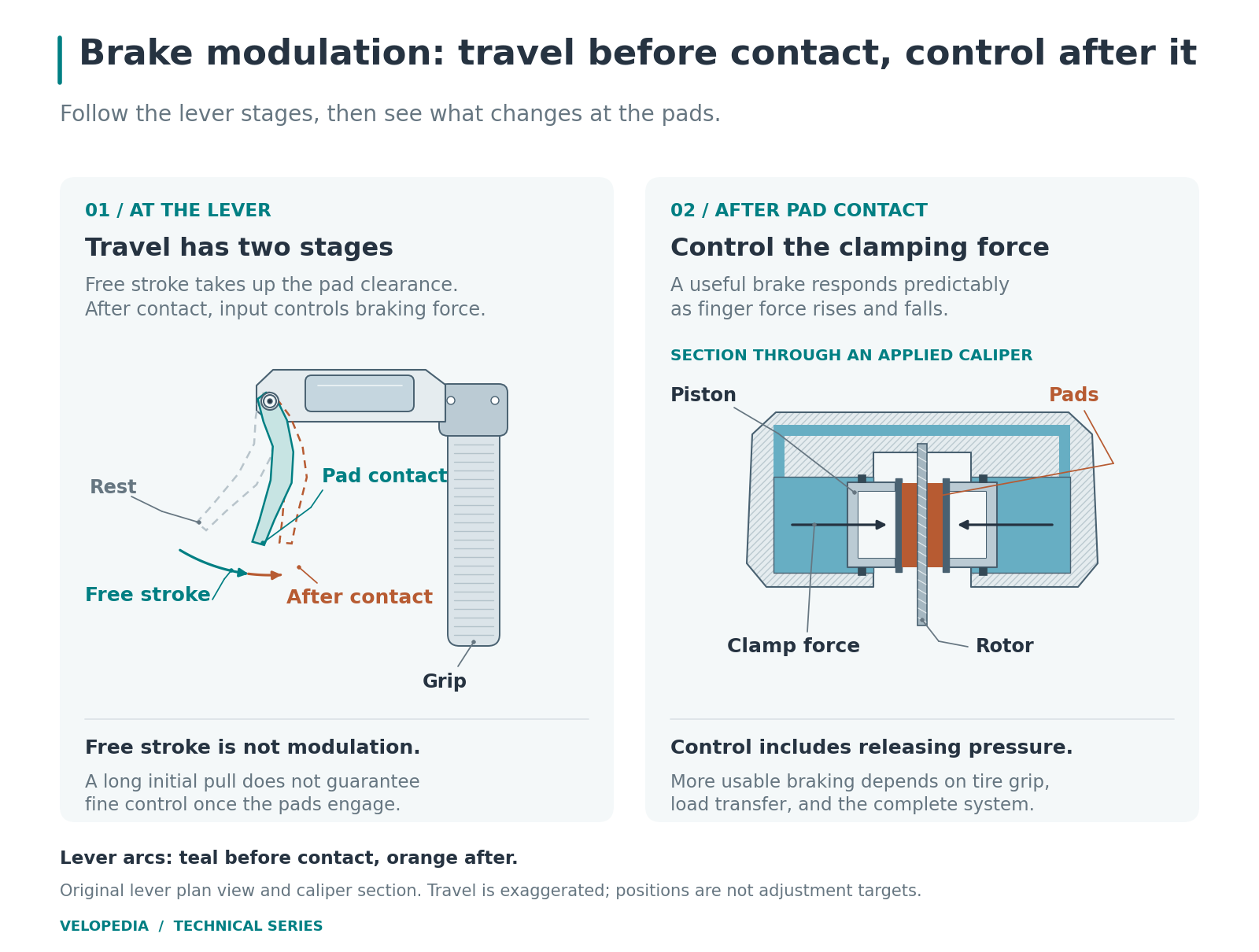
Modulation is often confused with lever travel. A brake that moves a long distance before the pads contact the rotor does not necessarily have good modulation; it may simply have excessive free stroke or pad clearance. Similarly, a soft or spongy lever can provide more physical movement without providing better control.
Judge the predictable relationship between hand input and braking torque. Extra travel before engagement is a separate characteristic; it does not show how much control remains after the pads make contact.
Related Brake-Feel Terms
| Term | Meaning |
|---|---|
| Brake power | Informal shorthand for available braking force or torque; physical power is the rate of energy transfer |
| Free stroke | Lever movement before the pads contact the rotor or rim |
| Bite point | Position in the lever stroke where meaningful braking begins |
| Modulation | Control over braking-force changes after contact |
| Lever reach | Resting distance between the lever blade and handlebar |
| Lever firmness | Perceived system stiffness after pad contact |
| Initial bite | How quickly braking force rises immediately after contact |
These characteristics interact, but they are not interchangeable. A contact-point adjuster, for example, may change where braking begins without fundamentally changing the brake’s maximum power.
How It Works
Brake modulation is determined by the relationship between finger force, lever movement, pad force, and braking torque.
For a simple disc-brake model, torque depends on the combined normal forces at the two pads, their friction coefficient and their effective radius on the rotor:
Braking torque ≈ friction coefficient × (left pad force + right pad force) × effective rotor radius
The lever and the cable or hydraulic mechanism determine the pad forces. Friction converts those normal forces into tangential forces at the rotor; their moment about the axle produces braking torque. The equation assumes comparable friction at the two faces and is an explanatory approximation, not a brake rating.
A system does not need a perfectly linear response to modulate well. Some brakes deliberately use a rising leverage curve. What matters is that the response remains predictable and gives the rider enough usable control before reaching the traction limit.
Lever Geometry
The lever acts as a mechanical amplifier. Blade length, pivot position, finger position, cam profile, and master-cylinder or cable-anchor location all influence its leverage.
Some levers use a variable leverage ratio. Shimano’s Servo Wave system, for example, moves the pads rapidly during the initial lever stroke and then increases mechanical advantage after pad contact. This separates quick pad engagement from the portion of the stroke used to control braking force. Shimano Servo Wave Action
Mechanical advantage, how that ratio changes, pivot friction, blade stiffness and finger position all affect the response. Reach and contact-point settings help the rider place the useful stroke where it can be controlled, while preserving clearance from the handlebar.
Longer free stroke may make engagement feel less immediate, but free stroke by itself is not modulation. Excessive free stroke can instead reduce control by placing the useful part of the lever movement too close to the handlebar.
Hydraulic System Factors
In a hydraulic brake, pressure multiplied by piston area determines piston force. With opposed pistons, the combined forces on both pads depend on the sum of the relevant caliper-piston areas relative to the master-piston area; the lever contributes its own mechanical ratio. A larger force ratio also requires more master-piston displacement for a given amount of pad travel.
Seal friction and rollback, hose expansion, caliper and lever stiffness, fluid condition and temperature can all change response. Dirty or unevenly moving pistons and air in the system can introduce additional travel or inconsistent engagement.
Hydraulics generally eliminate much of the cable friction found in mechanical systems, helping produce a repeatable response. That does not mean every hydraulic brake has better modulation than every mechanical or rim brake. Lever ratio, pad behavior, stiffness, and system condition remain decisive.
Air in a hydraulic brake does not improve modulation. It creates compressibility, excessive lever movement, and potentially inconsistent engagement.
Mechanical System Factors
Mechanical disc and rim brakes transmit force through an inner cable and housing. Their modulation depends on:
- Lever and caliper cable-pull compatibility
- Cable friction
- Housing compression
- Cable routing
- Caliper leverage
- Pad clearance
- Caliper alignment
Cable friction can make the response depend on whether the lever is being pulled or released. At the same hand force, the delivered cable tension may differ between those directions. This history-dependent response is called hysteresis; sticking and sudden release can make fine corrections difficult.
High-quality cables, brake-rated compressionless housing, broad housing bends, and accurate caliper setup can substantially improve a mechanical brake’s control.
Caliper Pistons
Piston count does not determine modulation by itself.
A four-piston caliper may provide more pad support, heat capacity, and total piston area than a smaller two-piston design, but its response still depends on the master cylinder, lever ratio, piston diameters, seals, pads, and rotor.
Some four-piston calipers use different leading and trailing piston diameters to manage pressure distribution across the pad. Others use equal-size pistons. Neither arrangement guarantees a particular lever feel without considering the rest of the system.
Statements such as “two-piston brakes modulate better” or “larger pistons engage more abruptly” are therefore incomplete. The hydraulic and mechanical ratios must be evaluated as a system.
Pad Compound
Pad compound strongly affects initial bite, friction consistency, temperature behavior, noise, and wet-weather performance. However, organic and sintered pads cannot be assigned one universal feel across every manufacturer.
For example, Shimano describes its metal pads as having a more aggressive bite and its resin pads as producing a more ramped response. SRAM describes its organic pads as providing maximum bite and its sintered pads as better suited to sustained, wet-weather braking. These differences reflect manufacturer-specific compounds rather than a contradiction in brake physics. Shimano pad comparison, SRAM brake tuning guide
Choose an approved pad shape and compound for the brake, rotor and conditions. Compare that compound’s bite, sustained heat behavior, wet performance, noise and wear; the labels “organic” and “sintered” do not specify one universal response.
Changing compounds may also require preparing or replacing the rotor according to the brake manufacturer’s instructions.
Rotor Size and Construction
A larger rotor increases braking torque because the pads act farther from the wheel’s center. It also generally improves thermal capacity.
Increasing rotor size does not inherently reduce modulation. It reduces the finger force needed to produce a given amount of wheel torque. If the brake already has a high leverage ratio or aggressive initial bite, the increased torque may feel more sensitive, but that is a system-matching issue rather than an unavoidable property of large rotors.
How much torque changes depends on the starting effective friction radius and the new one. A 20 mm diameter increase is not one fixed percentage for every rotor pair. SRAM’s tuning guide gives changes of up to 14% when moving between rotor sizes in its system; treat that as guidance for the stated products, not a universal conversion. Respect the frame, fork, caliper, adapter and rotor-thickness limits.
Diameter sets the lever arm. Thickness, construction, lateral stiffness, thermal mass and brake-track design influence heat and deflection. Surface condition, runout and thickness variation can change the response even when the nominal rotor size is correct.
A warped rotor, loose hub, or inconsistent braking surface can create pulsing or a wandering contact point that may be mistaken for poor modulation.
System Stiffness and Feedback
A functioning brake usually has some elastic movement after pad contact: the pads and structures deform slightly as force builds. The rider senses both force and movement. That normal compliance is different from extra travel caused by air, a loose part or a damaged component.
Lever blades, hoses, housing, the caliper and its mounts, the frame or fork, and the pads can all contribute compliance. Rotor deflection also consumes movement, especially when a single-moving-pad caliper pushes it toward the opposite pad. Air in a hydraulic system adds unwanted compressibility.
The goal is controlled feedback, not maximum softness or maximum rigidity. A very stiff brake can still modulate well if its force curve and ergonomics are predictable.
Temperature and Consistency
A brake’s response may change with temperature as friction, fluid viscosity, seals, pistons and component clearances change. Glazing or other damage can leave a lasting change after the brake cools.
Heat-related loss of braking can reduce torque for a given input, while other thermal effects alter clearance or the bite point. Consistency over a descent matters as well as the feel of a single cold stop. Use the Brake Fade entry to separate those mechanisms.
Traction and Weight Transfer
Modulation is only useful relative to the available traction.
On level ground during deceleration, vertical tire loads shift toward the front wheel: front normal load rises and rear normal load falls. The rear can therefore lock with relatively little brake torque. Grade, rider position and changing contact with the terrain affect the loads as well.
Maximum braking may be limited by:
- Front or rear tire grip
- Surface conditions
- Rear-wheel lift as braking unloads the rear tire
- Rider position
- Tire pressure and construction
- Suspension movement
- Wheelbase and center-of-mass height
Locking the rear wheel in a parking lot is therefore not a meaningful test of overall brake capability or modulation. The ability to use high braking torque also depends on the loaded tire’s grip and on keeping the bike controllable.
In a turn, a tire is already generating lateral force. Braking asks it for longitudinal force as well, leaving less room for an abrupt input. The available grip changes with surface, load and lean; a predictable brake helps the rider respond to those changes rather than providing extra tire grip.
Modulation in Different Riding Conditions
Mountain Biking
Good modulation allows the rider to control speed on loose descents, maintain steering traction, and brake across roots or rocks without repeatedly locking the wheel.
Gravel and Cyclocross
Surface grip can change rapidly between hardpack, loose gravel, mud, and pavement. A predictable brake makes those transitions easier to manage.
Road Riding
On pavement, modulation matters during high-speed descending, corner entry, group riding, and wet conditions. The front brake can generate substantial deceleration, so precise control is more important than simply producing maximum force.
Commuting, Cargo, and E-Bikes
Higher system mass increases braking energy. Consistency through repeated stops and sufficient thermal capacity become as important as initial lever feel.
Mechanic’s Perspective
Brake modulation should be assessed only after the brake is correctly installed and functioning normally. A contaminated, poorly bled, misaligned, or unbedded system does not reveal the intended characteristics of its design.
Establish a Mechanical Baseline
Before evaluating feel:
- Secure the wheel and axle and check the hub for bearing play.
- Check rotor and pad wear, condition, retention and compatibility against the exact components’ specifications.
- Confirm caliper alignment and free movement, then set reach and any contact-point adjustment according to the lever’s instructions.
- Confirm suitable lever clearance and a complete release; bed new friction components using their prescribed procedure.
Rotor runout, hub play, or uneven piston movement can push the pads apart and cause the contact point to change from one lever pull to the next.
Separate Free Stroke From Modulation
With the bicycle stationary, observe where lever movement begins to engage the brake. This identifies free stroke and can expose excessive clearance; it does not measure modulation on a loaded tire.
After engagement, judge whether small changes in hand input produce controllable increases and decreases in braking. Once the mechanical checks pass, begin with gentle checks at walking speed in a clear, level area. Do not use a steep descent to evaluate a brake with an unresolved fault.
A long initial stroke followed by sudden power is not good modulation. It is delayed engagement followed by a steep force increase.
Hydraulic Brake Checks
For a hydraulic brake, verify the specified fluid and bleed procedure, piston movement and hose condition, then inspect the lever, caliper and fittings for leakage. Air, contamination, seal bypass or damaged parts can all produce an abnormal response.
A lever that feels firm initially but slowly moves toward the handlebar under constant pressure may indicate a hydraulic fault rather than a modulation characteristic.
Mechanical Brake Checks
For a mechanical brake, check lever-pull compatibility, brake-rated housing, cable friction, routing and ferrule seating. Confirm caliper-arm return and the correct pad clearances. A single-moving-pad caliper also consumes travel as it deflects the rotor toward its stationary pad.
Brake-rated compressionless housing can reduce housing movement where the manufacturer permits it. It cannot correct a wrong pull ratio, contaminated pads or a binding cable. Shift housing must not be substituted for brake housing.
Pad and Rotor Checks
A firm lever with weak braking warrants inspection of the friction interface as well as leverage and compatibility. Friction-related possibilities include:
- Contaminated pads
- Glazed pads
- Incorrect bedding
- Incompatible pad and rotor materials
- Severely polished or heat-damaged rotor surfaces
Bedding transfers a controlled layer of pad material onto the rotor. An uneven transfer layer can create pulsing or abrupt changes in friction. SRAM identifies contamination and improper bedding as common causes of persistent brake noise and inconsistent rotor deposits. SRAM disc-brake troubleshooting
Common Symptoms
| Symptom | Checks and possible causes |
|---|---|
| Long movement before engagement | Excessive free stroke, pad clearance, rotor knockback, air, cable adjustment |
| Spongy lever after contact | Air, hose expansion, housing compression, caliper or mount flex |
| Firm lever but weak braking | Contamination, glazing, poor bedding, undersized rotor, unsuitable pads |
| Power arrives suddenly | Aggressive system ratio, pad behavior, uneven transfer layer, sticking cable or pistons |
| Bite point changes while riding | Rotor runout, hub play, pad knockback, air, piston imbalance |
| Brake feels good cold but fades hot | Pad or rotor overheating, fluid condition, insufficient thermal capacity |
| Brake does not release smoothly | Sticky pistons, cable friction, damaged housing, contaminated caliper |
| Pulsing once per wheel revolution | Rotor runout, thickness variation, uneven pad deposits |
Modulation should be judged under realistic operating temperature and terrain. A brief stand test can identify faults but cannot reproduce sustained braking or traction changes.
Notable Implementations
Shimano Servo Wave
Uses a variable lever ratio to produce rapid initial pad movement followed by increased mechanical advantage after contact. It demonstrates that free stroke and braking-force control can be shaped separately.
SRAM Contact Point and Brake Tuning
Selected SRAM levers provide independent reach and contact-point adjustment. SRAM also treats rotor type, rotor diameter, and pad compound as system-level tuning choices rather than isolated upgrades.
Hope Tech 4
Uses reduced seal friction, a bearing-supported lever pivot, and external reach and bite-point adjustments. Hope distinguishes bite point—the lever position where the pads contact—from the brake’s broader power and control characteristics. Hope braking guide, Hope Tech 4 introduction
Common Misconceptions
“More Lever Travel Means More Modulation”
Not necessarily. Travel before pad contact is free stroke. Excessive free stroke may leave less usable lever range after engagement.
“A Soft Lever Has Better Modulation”
Extra softness may come from air, excessive housing movement, flex or a fault. Some elastic movement is normal; predictable force control and safe lever clearance are the relevant checks.
“Hydraulic Brakes Always Modulate Better”
Hydraulics usually reduce cable friction and provide consistent pad compensation, but system design and condition determine the result.
“Four Pistons Automatically Improve Modulation”
False. Piston count alone does not define hydraulic ratio, lever response, or pad behavior.
“Organic Pads Always Have Softer Bite”
False. Compound characteristics vary by manufacturer and model.
“Larger Rotors Destroy Modulation”
False. Larger rotors increase torque and reduce required hand force. Whether the result feels overly sensitive depends on the rest of the system.
“A Powerful Brake Cannot Modulate Well”
Power and modulation are separate. A brake can provide both high maximum torque and precise control below that maximum.
“If the Rear Wheel Locks, the Brake Is Powerful”
Rear-wheel lockup is strongly influenced by forward weight transfer and reduced rear-tire load. It says little about sustained power or modulation.
Related Terms
Brake Power
Hydraulic Disc Brake
Mechanical Disc Brake
Brake Fade
Rotor Size
Pad Compound
Lever Reach
Free Stroke
Contact Point
Traction
References
- Shimano: Servo Wave Action
- Shimano: metal and resin pad behavior
- Shimano: hydraulic brake operation and safety
- SRAM: brake tuning guide — compounds and rotor steps
- SRAM: reach, contact-point adjustment and bed-in
- SRAM: rotor overview
- SRAM: disc-brake troubleshooting
- Hope: complete guide to braking
- Hope: Tech 4 lever design
- Trek: owner guidance on braking, traction and rear-wheel lift