
- Frame
- Alpha SL aluminum
- Groupset
- Mountain Mix
Velopedia Bicycle Archive
Compare Bicycles
Compare published geometry, gearing and specifications for up to three bicycles.
Edit comparison
Add a bicycle
Search the Archive without leaving this comparison.
1 of 2 bicycles
At a glance
Key differences
Supported differences are shown below. Data limitations are labeled separately.
- Gearing
2000 Trek Navigator 200 has a 12% lower climbing ratio than 1999 Trek Navigator 200.
A lower ratio gives more mechanical advantage; rear-wheel rollout determines distance per crank turn.
Gearing comparison
Lower gears help on climbs. Higher gears suit higher speeds.
RPM
RPM = pedal turns per minute.
Lowest0.82:1Highest3.69:1Total range448%
Estimated speed at 90 RPMLowest gearHighest gear
Uses front tire 26×1.95; rear size isn’t listed.
Lowest0.93:1Highest4.36:1Total range468%
Estimated speed at 90 RPMLowest gearHighest gear
Uses front tire 26×1.95; rear size isn’t listed.
How it works
Ratio = front teeth ÷ rear teeth. Hub gears also include the hub’s internal ratio. A 400% range means the highest ratio is four times the lowest.
Speeds are estimates from tire size and pedal cadence. Actual speeds vary.
Complete specification tableShows different published values and gaps where a bicycle lacks data. Different wording reflects source language, not necessarily different components. Swipe for more columns.
Specification
2000 Trek Navigator 200
1999 Trek Navigator 200
Overview
Model Year
2000
1999
Brand
Trek
Trek
Model
Navigator 200
Navigator 200
Bicycle Type
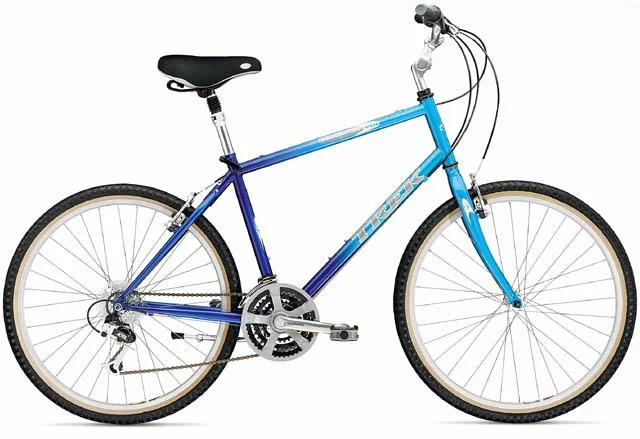
Mountain bike, non-suspension
Mountain bike, non-suspension
Original MSRP
$329.99
$299.99
Colors
Rain Forest, Silver metallic/Slate fade
—
Sizes
12", 14.5", 16.5", 18.5", 21", womens 14.5", womens 16.5"
L, M, S, womens large, womens medium, XL
Weight
—
29 lb
Frameset
Frame Construction
TIG-welded
TIG-welded
Frame Material
Alpha SL aluminum
Chromoly seat tube/hi-tensile steel
Fork
Trek
Trek
Fork Material
Hi-tensile steel, unicrown crown
Hi-tensile steel
Drivetrain
Component Group
Mountain Mix
Mountain Mix
Shifters
Shimano C102
Grip Shift MRX-170
Front Derailleur
Shimano C102
Shimano Tourney TY-32, bottom-pull/clamp-on 31.8mm
Rear Derailleur
Shimano C101
Shimano Altus
Crankset
Shimano C102, 28/38/48 teeth
Shimano Tourney TY-30, 28/38/48 teeth
Bottom Bracket
—
Tien Hsin BB-7700
Rear Cogs
7-speed, 13 - 34 teeth
8-speed, 11 - 30 teeth
Chain
1/2 x 3/32"
KMC Z-51, 1/2 x 3/32"
Pedals
MTB nylon
Platform
Brakes
Brakes
Aluminum linear-pull brakes, Shimano levers
Chang Star VB-965 D brakes, Grip Shift IBS MRX levers
Cockpit & Contact Points
Headset
1 1/8"
1 1/8" Victor VP-H992W
Handlebar
Riser
Steel, rise
Handlebar Extensions
Not included
Not included
Stem
Aluminum, adjustable
Aluminum, adjustable
Saddle
Oasis Webspring Comfort
Velo
Seatpost
Aluminum, suspension
Polygon, suspension, 27.2mm diameter
Wheels & Tires
Hubs
Aluminum, Q/R
Front: alloy, Rear: Kung Ten aluminum, nutted
Rims
Alloy
Weinmann 519, 32-hole
Spokes
Stainless steel, 2.0mm straight gauge
Stainless steel, 2.0mm straight gauge
Spoke Nipples
Brass nipples
Brass nipples
Front Tire
26 x 1.95" Trek Millenia Comfort
26 x 1.95" street tread
Wheel Size
26" wheels
26" wheels
Geometry · choose a size for each bicycle
Geometry size
Head-tube angle
70.5°
70.5°
Seat-tube angle
73°
73.5°
Chainstay / rear center
—
435 mm
Wheelbase
—
1032 mm
Fork offset / rake
96.5 mm
38 mm
Historical specifications are presented as an archival reference. Components may have varied by market, size, or production run. Legacy reference geometry is model-level historical data whose corresponding frame size is not identified; compare those dimensions as reference values rather than size-normalized fit data.