
Switch Infinity is Yeti Cycles’ rear-suspension system with a lower pivot that slides upward, then reverses and slides downward as the suspension compresses. An upper rocker and this sliding pivot guide a rigid rear triangle. The rear axle can keep moving upward while the lower pivot changes direction.
The mechanism gives Yeti a way to shape pedaling support through the stroke. Axle path, leverage, braking response and shock setup still belong to the particular frame; the Switch Infinity name does not specify one universal ride characteristic.
Key Facts
First Production Model: 2015 Yeti SB5c
Category: Suspension Technology
Also Known As: Translating Pivot Suspension, Infinity Link
Developed By: Yeti Cycles in collaboration with FOX
Used By: Yeti Cycles
Found On: Selected Yeti trail, all-mountain, and enduro bikes
Core Design: Four-bar linkage with a direction-changing translating pivot
Service Requirement: Periodic cleaning and greasing of the sliding bushings
Official Website: Yeti Switch Infinity
Overview
The system evolved from Yeti’s earlier Switch Technology, which used an eccentric mechanism to reposition the lower pivot. Yeti combined that direction-changing concept with elements of its earlier rail-based suspension work to create Switch Infinity. The 2015 SB5c was the first production model to use it, followed by the longer-travel SB6c and numerous later platforms. Yeti’s bike history documents the SB5c as the first Switch Infinity model.
At the center of the system is the Infinity Link, a compact assembly manufactured for Yeti by FOX. A pivot carrier slides on two Kashima-coated rails through greased bushings. As the rear suspension compresses, the carrier initially moves upward, reaches a reversal point, and then moves downward.
Yeti describes the design goal as useful anti-squat around the pedaling region, followed by a reduction deeper in travel. The slider is part of how that curve is shaped. Its direction alone cannot tell you the percentage at a given point or how a particular bike will respond under power.
Switch Infinity, the earlier eccentric Switch mechanism and Sixfinity are different designs. Sixfinity uses a six-bar arrangement with rotating links. It now appears on both electric and non-electric bikes, including the LT.
How It Works
1. Four-Bar Architecture
Switch Infinity is described as a four-bar system. In the ideal planar guiding mechanism, the four rigid members are:
- Front triangle: the fixed reference, including the rail supports.
- Rear triangle: one rigid assembly carrying the rear axle.
- Upper rocker: the rotating connection between frame and rear triangle.
- Pivot carrier: the sliding connection between frame and rear triangle.
A conventional dual-short-link design guides the rear triangle with two rotating links. Here, the lower guide is a slider. Three revolute joints allow rotation, and one prismatic joint allows the carrier to translate. Together they permit one coordinated suspension movement. The two parallel rails guide the same carrier; they are not two independent suspension motions.
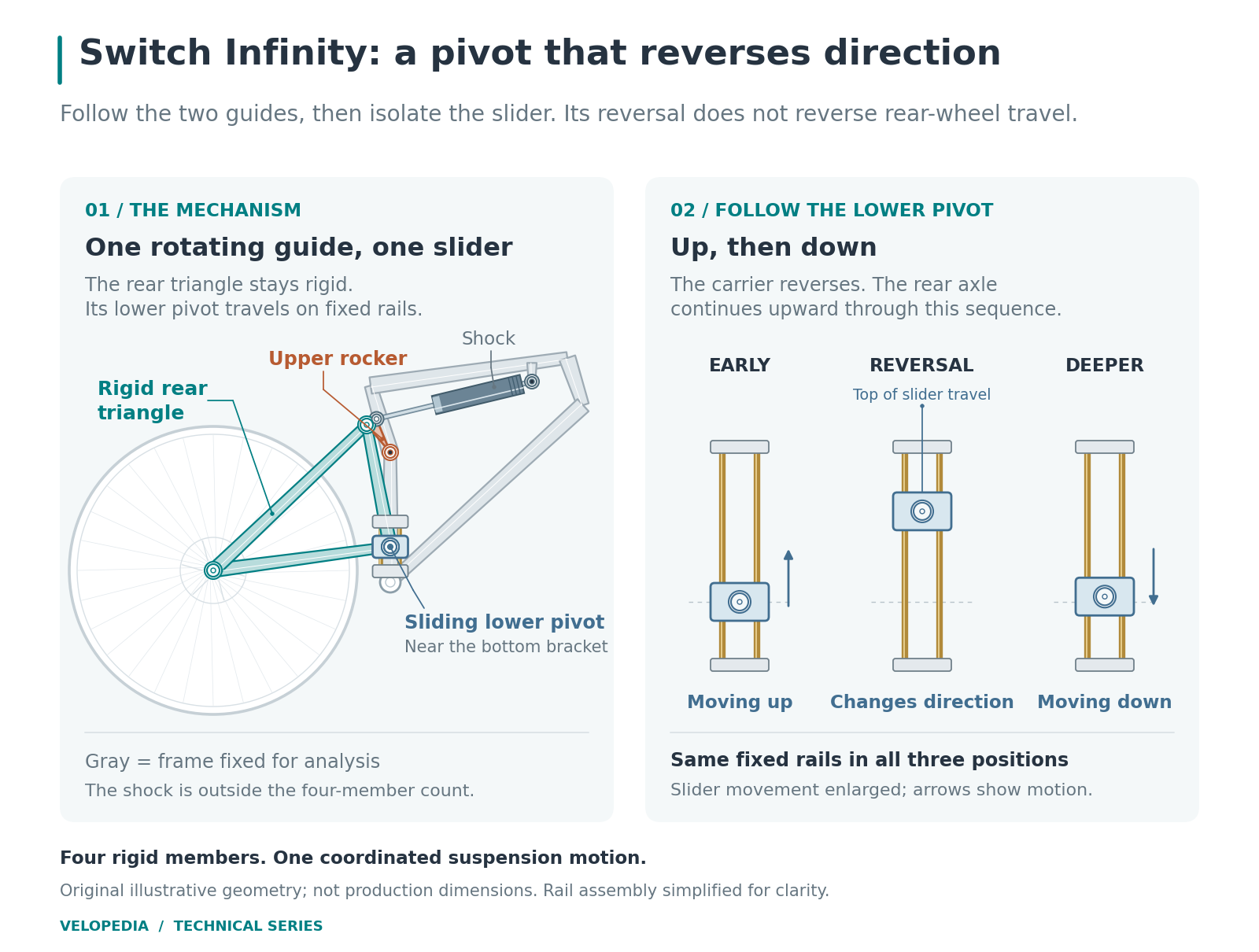
The rear shock resists that motion through its spring and damper; it is outside the usual four-member guiding count. The complete linkage determines the axle path and changing instant center. Shock mounts, drivetrain routing, brake location and load assumptions are also needed to calculate leverage and force response.
2. Beginning and Middle of Travel
Early in compression, the carrier rises on its rails while the upper rocker rotates. This is the part of the motion Yeti associates with sustained pedaling support. Use the actual model’s curve and its stated assumptions to judge how much support is present near sag.
Anti-squat compares the suspension’s response to driving forces with the compression tendency from acceleration-related rearward load transfer. Gearing and the assumed combined center of mass of rider and bike matter. At 100% anti-squat, those modeled tendencies balance; rider movement and bumps can still move the suspension.
On the trail, suspension movement under pedaling also depends on:
- Shock compression damping
- Spring rate and air-can volume
- Rider position
- Selected gear
- Pedaling cadence
- Chain tension
- Suspension friction
High anti-squat does not directly specify pedal kickback. Actual crank feedback depends on the chain route and required chain movement, selected gear, wheel and crank motion, and whether the freehub is engaged. A coasting impact and a heavily loaded pedal stroke can therefore feel different at the same suspension position.
3. Direction Reversal
Partway through the stroke, the translating pivot reaches the top of its path and reverses direction. The carrier then begins moving downward as the suspension compresses farther.
Yeti uses the changing geometry to reduce anti-squat later in the stroke. That describes response to driving forces under specified conditions. It does not mean the drivetrain becomes disconnected, or guarantee better bump absorption solely because the carrier has started descending.
The change of direction is continuous. At the turning point, the carrier’s vertical velocity momentarily reaches zero before becoming downward; the rear triangle can still rotate and the axle can still rise. No clutch, valve or electronic command triggers this reversal.
4. Deep-Travel Behavior
After reversal, continued wheel movement drives the carrier downward. The entire linkage and both shock-mount positions determine the leverage curve. Using wheel movement divided by shock compression as the ratio, a falling ratio is progressive. Spring characteristics and damping also contribute to support and bottom-out resistance.
The translating pivot’s downward movement does not mean the rear axle also moves downward or becomes progressively more rearward. The slider path and axle path are different measurements. The axle follows a curved trajectory determined by the entire four-bar geometry.
Similarly, pivot reversal does not automatically flatten or increase the leverage ratio. Yeti develops a separate leverage curve for each frame and shock configuration. This is why two Switch Infinity bikes can feel different even though their sliding mechanisms appear similar.
5. Infinity Link Construction
The Infinity Link contains:
- Two Kashima-coated rails
- Greased sliding bushings
- Wiper seals
- A translating pivot carrier
- External grease ports
- Main-pivot bearings and associated hardware
The rails are not miniature shock absorbers and do not contain an air spring or damper. They simply guide the pivot carrier along its prescribed path.
Service hardware has changed between generations. The MY26 SB160 manual, for example, includes separate V1 and V2 main-pivot bearing procedures. Identify the installed assembly and use its specified kit, spacers and instructions; similar appearance does not establish compatibility.
Performance Characteristics
Pedaling Support
Switch Infinity’s principal design objective is to retain useful anti-squat through the portion of travel most commonly occupied while pedaling. This gives the bike chassis support under acceleration without relying entirely on firm shock compression damping.
To assess pedaling support, first establish the recommended spring setting and sag. Then compare the same climb with a consistent gear and rider position. A low-riding or unsettled rear end may reflect spring rate, damping, friction or rider input; adding compression damping is not a universal cure.
Bump Response
A lower anti-squat value indicates less modeled opposition to acceleration-related squat under the stated assumptions. It is not a direct measure of bump force, shock damping or energy loss. Coasting, freehub engagement and chain loading affect whether drivetrain forces materially influence a particular impact.
Small-bump sensitivity is also affected by shock setup, seal condition, pivot friction, tire pressure, and whether the rider is pedaling or coasting. Switch Infinity alone does not determine how supple a bike will feel.
Mid-Stroke and Bottom-Out Support
Mid-stroke support comes from the frame’s leverage curve working with the shock spring and damper. Bottom-out resistance also depends on the end of those curves and any bottom-out control. The upper rocker matters, but its effect cannot be separated from the slider, rear-triangle geometry and shock mounts.
An SB120 and an SB160 share the basic mechanism but serve different travel and riding requirements. Their model-specific leverage curves, shock dimensions and tunes are the useful comparison. The shared slider does not establish air- or coil-shock compatibility for an unverified replacement.
Braking Behavior
Rear braking still interacts with the suspension. Anti-rise compares the brake-induced suspension tendency with the extension tendency caused by braking-related rearward unloading. The caliper’s mounting member, linkage, combined rider-and-bike center of mass and assumed braking distribution all enter the calculation.
At 100% anti-rise, those modeled tendencies balance; the suspension remains able to move over bumps. A higher or lower percentage does not establish a traction ranking. Assess ride height and rough-ground control with the actual tires, springs, damping and rider technique.
Design Trade-Offs
Compared with a direct single-pivot layout, Switch Infinity adds a rotating guide and a sliding guide with their associated service interfaces. The useful ownership comparison is the actual parts, access and maintenance work on each frame.
Potential trade-offs include:
- Sliding surfaces and seals requiring clean conditions and scheduled lubrication
- A proprietary mechanism with model-specific hardware and service kits
- Separate procedures for pivot bearings and the sliding mechanism
- Access and clearance dictated by the intended frame
The system’s position near the bottom bracket also exposes it to water, dust, and debris from the rear tire. Fender coverage, intact seals, and routine cleaning therefore matter.
Maintenance and Service
Start with the manual for the exact frame and installed mechanism. The MY26 SB160 manual, page 21, specifies lubrication at 40 riding hours. Yeti’s general support chart and the FOX guide also show condition-dependent intervals. These are different published instructions, not values to average into a new schedule.
If the frame manual and general guide appear to conflict for your use, confirm the applicable interval with Yeti or its dealer. Mud, heavy dust and frequent washing affect service needs. Keep a record of riding hours and inspection findings so the next service is based on the bike’s actual use.
Routine lubrication follows the approved procedure. Access is model-specific: the SB160 manual, page 15, describes moving the swingarm aside after removing specified main-pivot hardware. This is more than simply adding grease to an exposed port. Once access is established, the basic sequence is:
- Cleaning dirt from the link, rails, seals, and grease ports.
- Inspecting the rails for damage or abnormal wear.
- Injecting the approved grease through both ports with the specified needle fitting.
- Stopping when fresh grease begins to appear at the seals.
- Wiping away all expelled grease and contamination.
FOX says external lubricant is unnecessary on the shafts and seals. Its 10–15-hour “minimum interval” is a warning against overly frequent lubrication, not an instruction to grease every ride.
The link should also be checked for:
- Lateral play
- Rough or notchy movement
- Damaged seals
- Corrosion around bearings or hardware
- Uneven rail wear
- Persistent creaking after other pivots are inspected
Distinguish lubricating the link from opening its sliding mechanism. FOX limits user maintenance to cleaning and greasing and warns against disassembling the mechanism because its shaft-bearing preload requires special tools. Yeti separately documents main-pivot bearing replacement for applicable versions. A bearing procedure is not permission to dismantle the rail assembly.
Mechanic’s Perspective
Begin an inspection with the complete rear end. Play felt at the wheel can originate in the hub, axle, shock hardware or another frame pivot, and noise can travel through the frame. Identify the moving interface before condemning the slider.
When inspecting a Switch Infinity bike, a mechanic should:
- Check the rear wheel, hub bearings, shock hardware, and conventional frame pivots before attributing play or noise to the Infinity Link.
- Support the bike and load the rear assembly gently while feeling the suspected interfaces. Brake-pad movement can be mistaken for pivot play during a brake-on rocking check.
- If the prescribed procedure requires disconnecting the shock or a link, support the rear assembly first. Move it only through the permitted range without straining hoses or forcing the mechanism.
- Inspect both rails for scoring, corrosion, discoloration, or uneven wear.
- Check the wiper seals for damage and confirm that the pivot carrier moves without lateral play.
- Verify all pivot axles and bearing hardware with the model-specific torque chart.
If grease will not enter a cleaned port or the expected purge does not appear, stop and check the fitting and applicable service instructions. Extra pressure is not a diagnosis. A damaged fitting or an obstruction needs attention before more lubricant is added.
Grease cannot repair worn bushings, scored rails or a loose bearing fit. Persistent play calls for locating the source and following the relevant service or replacement procedure. Do not increase fastener torque beyond specification to conceal movement.
For used-bike inspections, visible rail damage, neglected grease ports, persistent pivot play, or rough movement should be considered potential service costs. A clean mechanism with intact seals and documented maintenance is a better indicator than cosmetic frame condition alone.
Before quoting work, confirm the installed mechanism version, required replacement parts, prescribed tools and access procedure. Include pivot hardware and bearing inspection in the estimate. A documented service history helps, but it does not replace checking the mechanism’s present condition.
Setup Considerations
Set sag using Yeti’s instructions for the exact model and shock, then adjust rebound and compression. Shock sag percentage uses shock stroke as its denominator; it is not automatically the same percentage of wheel travel. Changing sag moves the operating point along the existing kinematic curves rather than changing the linkage geometry.
Common setup errors include:
- Excessive sag that places the bike beyond its intended pedaling region
- Too little sag, reducing traction and small-bump compliance
- Excessive rebound damping that causes packing on repeated impacts
- Changing air-spring volume solely to chase full travel on every ride, without considering harshness, support and the impacts being ridden
- Attempting to correct spring-rate problems with compression damping
Changing shock stroke, eye-to-eye length, or linkage components can alter frame clearance and kinematics and should only be done where Yeti specifically approves the configuration.
Notable Implementations
Yeti SB5c: First production Switch Infinity model, introduced for the 2015 model year.
Yeti SB6c: Early long-travel enduro application that helped establish the platform in racing.
Yeti SB120: A 120 mm trail application of Switch Infinity.
Yeti SB140: 140 mm all-mountain platform with model-specific leverage and anti-squat characteristics.
Yeti SB160: 160 mm 29-inch enduro race bike using Switch Infinity and revised pivot hardware.
Yeti SB165: Long-travel applications; wheel configuration and service details differ between generations, so identify the model year.
Related Terms
- Anti-Squat
- Anti-Rise
- Instant Center
- Axle Path
- Leverage Ratio
- Four-Bar Suspension
- Virtual Pivot
- Sixfinity
- Suspension Sag
References
- Yeti: Switch Infinity Technology
- Yeti: How Switch Infinity Works
- Yeti: Switch Infinity Maintenance and General Interval Chart
- Yeti: Bike History — SB66 Switch and SB5c Switch Infinity
- FOX: Yeti Infinity Link User Guide
- Yeti: MY26 SB160 Owner’s Manual — Service and Version-Specific Bearings
- Yeti: Owner’s Manual Index
- Yeti: Sixfinity Technology
- Yeti: LT Specifications and FAQ